The nature of aerial warfare is changing rapidly. As military powers around the world invest in artificial intelligence, autonomous systems, and sixth-generation technologies, France has unveiled an ambitious roadmap for the future of its flagship combat aircraft—the Rafale F5. More than a routine upgrade, the F5 standard represents a transformational leap in combat aviation, designed to ensure that the Rafale remains one of the world’s most capable multirole fighters well into the next decade.
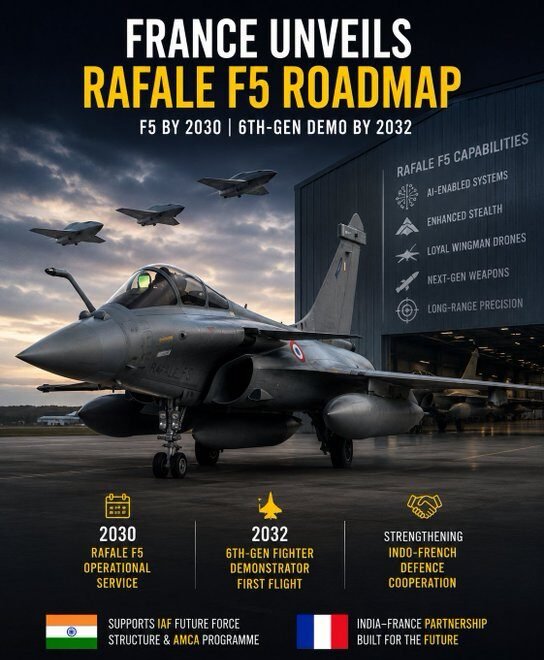
According to the roadmap, the Rafale F5 is expected to enter operational service by 2030, while France aims to fly a sixth-generation fighter demonstrator by 2032. These milestones highlight France’s long-term commitment to maintaining technological superiority in an increasingly complex global security environment.
Unlike previous upgrades that focused primarily on avionics, sensors, or weapon integration, the Rafale F5 introduces a fundamentally different approach to air combat. Modern battlefields are becoming increasingly interconnected, demanding seamless coordination between aircraft, drones, satellites, cyber networks, and ground forces. The Rafale F5 has been conceived to operate at the heart of this highly networked ecosystem, where information dominance is as critical as firepower.
Artificial Intelligence is expected to play a central role in the aircraft’s evolution. Rather than replacing the pilot, AI will function as an intelligent assistant capable of processing vast amounts of battlefield data in real time. It will help identify threats, recommend tactical responses, coordinate mission planning, and improve decision-making under combat conditions. This will enable pilots to focus more effectively on mission execution while reducing cognitive workload during high-intensity operations.
One of the most significant advancements in the Rafale F5 programme is its planned integration with loyal wingman drones. These unmanned aircraft are designed to fly alongside the manned fighter, carrying out dangerous missions such as electronic warfare, reconnaissance, intelligence gathering, decoy operations, and precision strikes. By operating as force multipliers, loyal wingman drones can extend the fighter’s operational reach while reducing risks to pilots in contested environments. The concept represents one of the defining characteristics of next-generation air combat and is increasingly being pursued by major military powers across the globe.
The Rafale F5 will also feature enhanced stealth characteristics, improved electronic warfare capabilities, advanced sensor fusion, and the ability to employ next-generation long-range precision weapons. These upgrades are intended to improve survivability against increasingly sophisticated air defence systems while enabling the aircraft to operate effectively across multiple domains, including land, sea, air, space, and cyberspace.
For India, the Rafale F5 roadmap carries particular strategic significance. The Indian Air Force already operates Rafale fighters, which have become an integral part of India’s frontline air combat capability. While there has been no official indication that India will acquire the F5 variant, the technological direction outlined by France is likely to be closely studied in New Delhi. The roadmap aligns with India’s broader efforts to modernize its air power and develop indigenous capabilities through programmes such as the Advanced Medium Combat Aircraft (AMCA).
The growing defence partnership between India and France has evolved well beyond aircraft purchases. In recent years, the two countries have expanded cooperation in defence manufacturing, technology transfer, joint military exercises, maritime security, and aerospace research. As France advances technologies related to AI-enabled warfare, autonomous systems, and sixth-generation combat concepts, opportunities for deeper collaboration in research, innovation, and industrial partnerships could continue to grow.
France’s parallel objective of developing a sixth-generation fighter demonstrator by 2032 further demonstrates that the Rafale F5 is not the end of the aircraft’s journey but rather a bridge toward the next era of combat aviation. Around the world, future fighter programmes are increasingly focused on creating integrated combat ecosystems rather than standalone aircraft. Success will depend not only on speed or manoeuvrability but also on connectivity, autonomous teaming, cyber resilience, electronic warfare, and data-driven decision-making.
The unveiling of the Rafale F5 roadmap therefore represents more than the evolution of a successful fighter aircraft. It reflects a broader shift in military doctrine, where advanced technologies are reshaping the very nature of air warfare. As geopolitical competition intensifies and technological innovation accelerates, the Rafale F5 stands as a symbol of France’s ambition to remain at the forefront of aerospace excellence while offering trusted partners such as India a glimpse into the future of aerial combat.
For defence planners, military analysts, and aviation enthusiasts alike, the Rafale F5 is not simply the next version of an iconic fighter—it is a statement of where modern air power is headed in the decades to come.